
Take a walk with me, friend. Let the fresh air fill your lungs. Take a break from the hustle and bustle of life, the noise of civilization, and ask your questions. I will do what I can to answer them.
You wish to write a fantasy novel, but struggle with writing a convincing world? Tell me, how much research have you done on the workings of our world? Not much, I see. Would you believe me if I told you that understanding our world is the foundation of building your own?
Well, of course researching how a world operates is as daunting a task as creating one from scratch. There are a few bits of wisdom I can pass on to aid you in this endeavor.
How do I know what to research?
As with any research project, you must begin with a research question. What is your setting? Do you need to know how a whole planet works, or just one continent? Do you need one culture? One city? One section of a city? Try listing the settings you use in your manuscript, and then determining which of those settings are important to worldbuilding. For instance, a cottage that appears in a dialogue-driven, three-page scene won’t have nearly the worldbuilding importance as the tavern the resistance uses as a front for their secret headquarters. Decide first what settings need your focus.
Once you have narrowed down your focus, decide what questions readers are likely to have about it. For example, the question may be “what does this place look like?” Consider not only the colors of the walls and curtains, but the architecture itself. Is your world based in medieval culture? Which one? What specific styles are common in your world? Draw from real cultures and architecture for this. Look at pictures of the sorts of buildings you want in your world, and describe them in your prose.
Where do I find sources?
The sources you’ll find most useful depend on your research questions, but for worldbuilding, I have found Pinterest to be an invaluable resource. It allows you to easily browse thousands of pictures from a search, as well as save and categorize them. You can use these visual aids to help you describe people, places, animals, objects, seasons, clothing, and so much more.
If your story is rooted in real-life cultures, you may draw significant inspiration from encyclopedias, documentaries, archeological findings, historians, museums, nonfiction books, and things of that nature. These sorts of sources can teach you how those cultures, political systems, and religions worked (and still work) in our world.
How do I choose good sources?
In the digital age, it’s easy to become overwhelmed with the influx and availability of information. Credibility can be difficult to verify without training, these days. But there is hope! You can easily look for general credibility of different sources based solely on how they are accepted by the fields in which they write. For example, a documentary on zebras by National Geographic will have more general credibility than a blog post by someone who visited a zoo.
Whether a source is appropriate for your project will depend on the content of the source and your needs. If you need a hierarchy of the servants of a queen in medieval Europe, a source that talks about the positions in a royal household will be more applicable than a few episodes of Downton Abbey–not to mention more credible!
How do I incorporate sources?
No, you don’t have to dig out your old citation handbook from English 101. Fiction writing is cool that way–you get to draw inspiration from your sources without citing them. Readers will expect some level of realism in your story, but it is not an academic paper. Use the sources for inspiration. Incorporate real-world positions, titles, jobs, architecture, folklore, and culture into your manuscript, but have fun! Make it yours. Perhaps the monarchs of your world are not kings or emperors, but potentates or overlords. You can base your world on aspects of ours, but remember: it is still your world.
More Sources
This short article from FirstDraftPro emphasizes the importance of research in worldbuilding. https://www.firstdraftpro.com/blog/conducting-worldbuilding-research#:~:text=Research%20and%20worldbuilding%20are%20crucial,and%20depth%20to%20your%20art.
Patricia C. Wrede’s Fantasy Worldbuilding Questions, appearing on the Science Fiction and Fantasy Writers Association website, can help you determine what your research questions should be. https://www.sfwa.org/2009/08/04/fantasy-worldbuilding-questions/
Grove City College has a publicly-accessible infographic for determining if a source is credible. https://hbl.gcc.libguides.com/research/credible
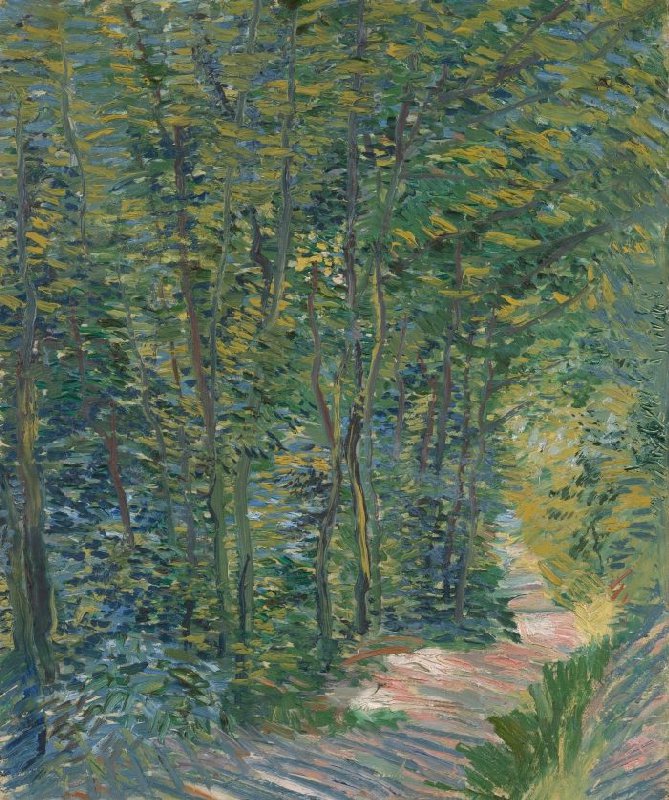
Heading image: Path in the Forest by Vincent van Gogh https://www.vangoghmuseum.nl/en/collection/s0080V1962
 The Book Forge
Leave a comment